
Podcasting Instructions
High Production Podcasting
Scripting: Round One
- Save your interview as an mp3. Use Premiere to transcribe your interview.
- Go through the transcript and highlight selections you want to keep and rearrange them in a coherent order.
- Go back to Audition and use this transcript to guide your selection of audio clips (your “audio selects”), pull them to a new track and rearrange them according to the transcript.
Scripting: Round Two
- Return to transcript and write narration around the audio selects to create transitions, offer context, fill in gaps in content, etc.
- Script an intro and outro.
- Identify characteristic sounds and soundtracks you will use; indicate these on this final transcript.
Sound Mixing
- Record intro/outro/narration (dialogue= between -9 and -12 db).
- Import sounds: characteristic sound, ambient sound, and soundtracks (between -18dB during gaps and -24db when dialogue).
- Align tracks. Export file as mp3.
Interviewing / Pre-Production
Interview Questions
(prepare/practice in advance; in the recording room, try not to read; try to converse casually)
Remember, the questions may end up edited out of the final podcast; the interviewee’s responses should be able to stand on their own, so encourage them to answer in complete sentences (and, sometimes, repeat part of what you asked, E.g. “What is noise pollution?” “ Noise pollution is….” Keep the tone conversational/don’t read
Fact Questions
Use these to get the interviewee to explain/describe the concept (e.g. “urban foraging” “tree equity” “floriculture” “soundscapes” “noise pollution”) and the place (Hyde Park, Hampstead Heath, Kew Gardens)
These work best at the beginning and throughout the middle of the podcast
- Can you introduce yourself?
- What is the current status of swimming in Hampstead Heath?
- What is tree equity?
- Could you explain to us what noise pollution is?
- Could you tell listeners what Hampstead Heath is and why it is important to open-water swimmers?
- What are the Garden Cemeteries in London?
Story Questions
Meant to elicit specific narratives. These usually work best in the middle of the podcast. You can help the interviewee along simply by saying “And then what happened?”
- Could you tell us what happened to Ella Adoo-Kissi-Debrah?
- How did palm trees end up in London?
- So, how, exactly, did we end up with cemeteries that people can use for recreation?
- How did the hedgehog population in Regent’s Park drop so dramatically?
- What’s the history of city farms in London?
- How did reformers keep Hampstead Heath from being privatized?
- What is the history of the Royal Parks? How were they created?
Reflection Questions
Questions that help us assign meaning to a narrative. They should prompt the interviewee to reflect on an experience. They often work best at the end of your podcast, and the responses often provide good quotes you can use to end the story.
- And how did it make you feel when you heard of the young girl’s death from pollution?
- What do you think about the enormous number of foxes in central London?
- Given what you’ve said about the air in Central London, how do you feel about the mayor’s plan to cut down on emissions?
- What do you think visitors should make of Kew Garden’s connection to slavery and colonialism?
- Is the fight for wild swimming at Hampstead Heath ponds worth it?
- How did you feel when you heard what gets dumped into the Thames?
- Do you feel any differently about Chelsea now that you know about tree equity scores?
- What’s your reaction to the takeover of London by these ring-necked parakeets?
Opinion Questions
These are good for wrapping up/final thoughts
- Should we visit and feed the ring-necked parakeets?
- Is it right to turn burial grounds into parks?
- Is there really anything that can be done about Thames pollution?
- Is London too noisy or is this a minor problem?
- How should the mayor of London deal with the air pollution?
- What are the benefits of open green spaces?
- Does everyone have a “right” to trees?
Try to avoid closed questions that can be answered with just a “yes” or “no.”
How to Organize These Responses: Facts, Stories, Reflection, Opinion
(Intro) Introduce listeners to speakers, the series, the episode, what’s to come
Facts
Orient the listeners—introduce and explain concepts; introduce and describe places (including their history and any necessary contemporary context); introduce and explain debates/controversies/issues. This should be the bulk of your podcast—it should be informed/informative, engaging, fluent, vivid/descriptive, and coherent. Listeners should understand the concepts you introduce and be able to visualize the places you describe.
Stories
These come next and help expand on the above
Reflection
Reflect on the things you discussed—what are your reactions to issues, challenges, controversies, suggestions, and arguments? Do you feel excited to go to this place? Do you feel inspired? Discouraged? Curious?
Opinion
Briefly: any opinions? Should people visit it and why/why not? Should people be concerned with/interested in/excited by this concept? Why or why not?
(Outro) Signoff w/your names and perhaps a tagline, provocative thought, thanks, goodbye, etc
Recording Instructions
The Equipment
- Plug the microphone into your laptop; the adaptor is already on it for Macs
- The headphones should already be plugged into the base of the microphone; make sure the connection is secure, and make sure the microphone stand is tightened (twist knobs for stability). If you both want to use headphones, use the splitter attached to the second set of headphones (watch for any noticeable changes to audio quality when using two headphones).
- Once everything is plugged in, the microphone light should come on.
- The Pattern dial should be turned to the figure 8 (Bi-directional), meaning it is picking up your voices from either side equally.
- The Gain dial controls how much volume is being picked up—if you speak quietly, it should be higher. Be aware that this will magnify every sound in the room.
- The Volume button only affects what you hear while recording. You might turn it loud enough that you can be sure to pick up on any sounds that might be distracting (and then try to eliminate them).
- When the mute light is *flashing, you are MUTED; be sure the red light is solid when you record.
- Go to Settings on your Mac and go to Sound. For Input, Select Blue Yeti Mic.
Audition
- Open Audition. Go to File-> New->Multitrack Session
- Title your podcast (be specific/pay attention to where you save it). Click “Podcast” for Template. Hit “Ok”
- Click on “Adobe Audition” on top toolbar🡪 Preferences🡪 Audio Hardware🡪Select Yeti for Input. Hit “Ok”
Record
- On Track 1 (the top track), Click on the box that says “None” 🡪Stereo—Yeti
- Click the red box w/R to record.
- Click the red circle at the bottom to begin recording (make sure mic red light is solid).Click white square to stop. You should see a green bar rising and falling as you speak (if it is hitting yellow, you may be too loud). If it is not moving, you are not recording.
- Test the volume and recording for a few seconds to make sure it is working.
- Drag Playhead (inverted blue triangle w/line running top to bottom on track) back to start to listen and check volume.
Edit
 Ctrl + Z= undo Ctrl + X= Cut
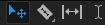
- Click on Move tool (blue triangle/far left), then click and drag the track wherever you want it (left/right or across tracks)
- Click on Time Selection Tool (capital I on far right) to select parts of the track (or Click “T”), then click and drag on the section you want to play or delete (hit delete once section is highlighted)
- Click on Razor (Blade second from left) and then click on two points to indicate piece you want to move or remove, then hit Move tool on that section to move, or hit Delete (can also use ctrl + K)
- Ignore Slip tool (side to side arrow)
- You can trim a clip by moving to either end, clicking on it, and dragging it in or out when a red bracket appears.
- You can name your Audio Selects by right clicking on them and selecting “rename”
Tutorial: https://producer.musicradiocreative.com/move-razor-slip-and-time-selection-tools-in-adobe-audition/
How to Record in Audition
Click here to enlarge video.
Editing in Audition
Click here to enlarge video.